This guide is based on research from veterinary and canine-health organizations, not on physical testing by Switchback Paws. Some links are affiliate links; see our Affiliate Disclosure.
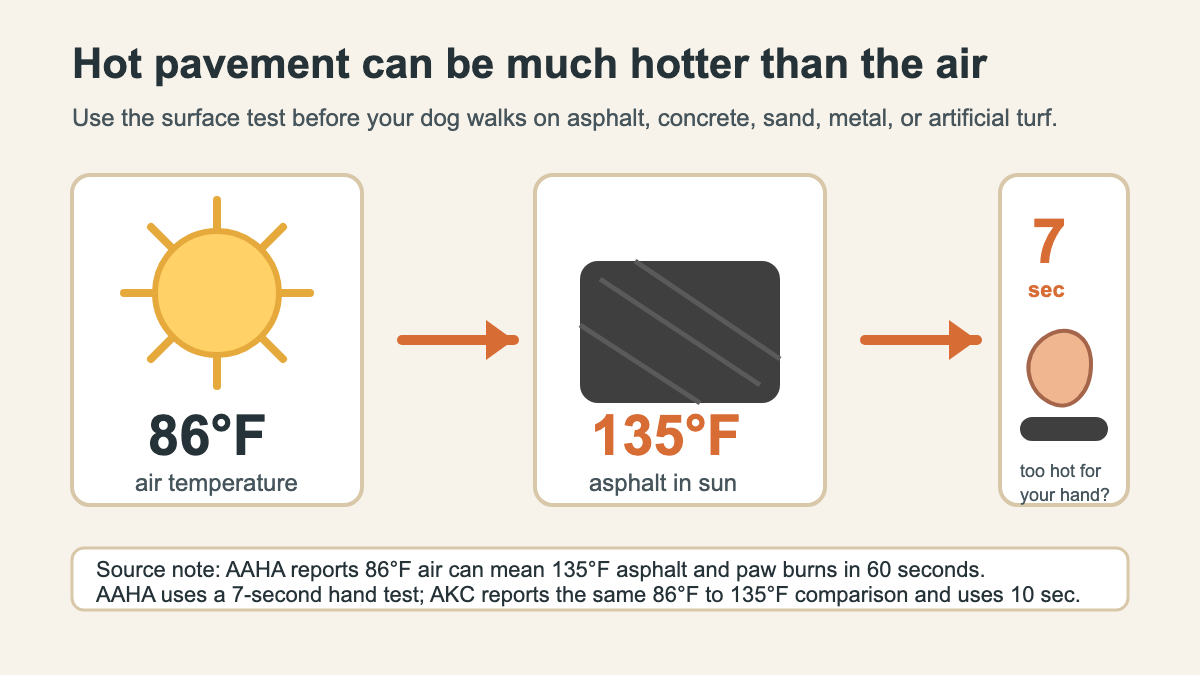
Short answer: if the air is around 85°F or higher and pavement has been sitting in direct sun, assume the ground may be too hot until you check it. AAHA reports that on a sunny day with 86°F air temperature, asphalt can reach 135°F and can burn a pet’s paws in 60 seconds. A practical field check is the back-of-hand test: hold the back of your hand on the surface for 7 seconds. If you cannot keep it there comfortably, choose grass, shade, a cooler time of day, or paw protection.
This is not about panic. It is about understanding that your weather app shows air temperature, while your dog is walking on surface temperature. Those can be very different numbers.
Air temperature vs. pavement temperature
Air temperature is measured above the ground and does not tell you how hot asphalt, concrete, sand, metal, or artificial turf feels under a paw. AAHA states that surface temperature can be 40-60°F hotter than air temperature in direct sun, especially on heat-absorbing materials.
| Air or surface condition | What the source says | Source used |
|---|---|---|
| 86°F sunny air temperature | Asphalt can reach 135°F and can burn paws in 60 seconds. | AAHA |
| 85°F or higher with no chance for pavement to cool | Ground may be too hot for safely walking a dog. | AKC |
| Surface temperature in direct sun | Can be 40-60°F higher than air temperature on materials like asphalt, concrete, sand, and metal. | AAHA |
The hand test: use 7 seconds, and know the limit
AAHA’s version is simple:
- Place the back of your hand on the pavement.
- Hold it there for 7 seconds.
- If you cannot keep your hand in place, it is too hot for your pet.
AKC gives a similar rule of thumb but uses 10 seconds. For this page, the main recommendation uses AAHA’s 7-second version because it is the more conservative veterinary-organization guidance. The test is still only a field check. Shade, wind, cloud cover, color of pavement, and time in the sun all matter. Recheck when the route changes from shade to sun.
What the numbers mean in real life
The 85°F and 86°F numbers are not magic cutoffs. They are warning points from the sources checked for this article. A cloudy 86°F day on pale concrete can feel different from a clear 86°F day on black asphalt. A shaded path can be usable while the sunny side of the same street is not. The safer way to use these numbers is to use them as a trigger for extra caution:
- If the forecast is in the mid-80s or higher, assume sun-exposed pavement needs checking.
- If the surface has been baking in the sun for hours, do not rely on air temperature alone.
- If your dog is slowing down, shifting weight, or trying to move toward grass, change surface immediately.
- If you are unsure, choose the cooler route instead of trying to finish the planned walk.
Different surfaces also behave differently. Asphalt is the classic risk because it is dark and absorbs heat. Concrete can still become uncomfortable, especially in open sun. Sand, metal ramps, truck beds, dock surfaces, artificial turf, and rubberized playground surfaces can all become hot enough to matter. The hand test works as a quick screen across these surfaces, but it should not replace watching your dog’s movement and comfort.
Signs your dog’s paw pads may be burned
AAHA lists several warning signs to watch for after hot-surface exposure:
- Limping or avoiding walking
- Licking or chewing at the paws
- Paw pads that look darker or redder than usual
- Blisters or intense redness
- Crying or whimpering
If you notice these signs, move your dog off the hot surface right away.
What to do if you suspect a paw burn
AAHA recommends getting your pet to a cooler area, gently rinsing the paws with cool water, avoiding ice or extremely cold water, and consulting a veterinarian for further advice. Do not keep walking to “see if it gets better.” Paw burns can be more serious than they look at first.
If you need to carry your dog or pause in shade, do that before checking the paws closely. A dog that is painful, overheated, or anxious may resist handling. Keep the response simple: get off the heat, cool the paws gently, keep the dog calm, and ask a veterinarian what to do next.
When and how to walk more safely in heat
- Walk early or late. Early morning and late evening are safer than midday sun because surfaces have had more time to cool.
- Choose cooler surfaces. Grass, dirt trails, and shaded routes are usually safer than asphalt or concrete.
- Shorten the route. Hot days are not the time to push distance.
- Check paws during and after. Look for rubbing, heat discomfort, or changes in gait.
- Use barriers carefully. Well-fitted dog boots or paw wax can add a barrier on hot ground, but boots must fit correctly and your dog needs time to adjust. If you are considering boots, start with how to measure your dog’s paws before comparing dog boots for hot pavement.
Boots are not a free pass to walk anywhere in extreme heat. They can protect paw pads from direct contact, but they can also change how your dog moves, trap warmth, or rub if the fit is wrong. Introduce boots indoors first, use short sessions, and check for rubbing. If your dog refuses to move normally in boots, do not make the first real attempt on hot pavement.
Paw wax is another barrier some owners use, but it is not the same as a shoe sole. It may help with friction and minor surface contact, but it should not be treated as permission to walk on ground that fails the hand test. For hot days, route choice and timing matter more than any product.
Simple walk plan for hot days
Before you leave, choose a route with grass or shade available every few minutes. At the door, test the first hard surface. During the walk, let your dog choose grass when possible and recheck pavement if the route moves into full sun. After the walk, look at the pads for redness, darkening, blisters, or unusual licking.
If the surface fails the hand test at the start, switch plans. A short potty break on grass, indoor enrichment, or a later evening walk is better than pushing through a route that is already too hot.
How we researched
This article is a research summary. It does not include pavement temperature testing by Switchback Paws. For the safety numbers, this article uses AAHA’s 2026 hot-pavement guidance, AKC’s updated hot-pavement article, and the accessible JAMA Network citation for Berens JJ, “Thermal Contact Burns From Streets and Highways.” AVMA’s warm-weather safety page is not used for numeric claims here because we could not verify the needed numeric language for this article.
Frequently asked questions
How hot is too hot for a dog’s paws? There is no single air temperature that works for every surface and every dog, but AKC warns that when the temperature is 85°F or higher and pavement has not had a chance to cool, the ground may be too hot for safe walking. Always check the surface itself.
At what temperature can pavement burn a dog’s paws? AAHA reports that when air temperature is 86°F on a sunny day, asphalt can reach 135°F and can burn a pet’s paws in 60 seconds. That is why the surface check matters more than the weather app alone.
How do I know if pavement is too hot for my dog? Use the back-of-hand test for 7 seconds. If you cannot hold your hand on the surface comfortably, it is too hot for your dog’s paws.
What are the signs of burned paw pads? Watch for limping, avoiding walking, licking or chewing paws, pad discoloration, redness, blisters, crying, or whimpering.
What should I do if my dog’s paws may be burned? Move your dog to a cooler area, rinse the paws with cool water, avoid ice, and contact your veterinarian for advice.
What time of day is safest to walk in summer? Early morning and late evening are usually safer than midday because pavement and sidewalks are cooler.
Keep reading:
- Dog boots for hiking and hot pavement
- How to measure your dog’s paws for boots
- Dog hiking gear checklist
This article is a research summary and does not replace professional advice. If your dog shows signs of paw injury, contact your vet.